Dooley Noted: 1/11/2014
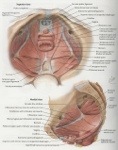
The pelvic floor (read: pelvic diaphragm) is a group of muscles that prevent your abdominal and pelvic organs from bottoming out. They also help you breathe, cough, copulate, urinate, defecate, and give birth.
Common symptoms, when the pelvic floor is too tense:
– painful sex
– difficulty in starting urine stream
– constipation
– urinating like a jet stream
Common symptoms, when the pelvic floor is too loose:
– incontinence
– impotence
– rectal and uterine prolapse
An attachment of the pelvic floor includes a tendon that is continuous with the fascia of obturator internus muscle.
Obturator internus is a lateral rotator of the hip when it is extended, or a hip abductor when the hip is flexed.
If the obturator internus is facilitated, it will drag the pelvic floor with it.
The converse also is apparent. When the obturator internus is not being properly utilized, the pelvic floor on the same side may become lax.
If one exhibits pelvic floor symptoms, get assessed. Ask the assessor to consider obturator internus, especially if you tend to cross the legs often or live with hip impingement (i.e., femoro-acetabular impingement syndrome).
If your hip impingement is not improving, ask to have your pelvic floor assessed.
Discussing pelvic floor dysfunction may be difficult for you to discuss. It’s not embarrassing to a professional. They’ve heard it all before. Be open and get on the road to resolution.
As always, it’s your call.
– Dr. Kathy Dooley