Dooley Noted: 1/24/2014
If I weren’t so motivated to educate, I would get frustrated by the number of people in my office prepping for knee surgery.
These patients have often been misled to believe that the structural findings on imaging warrant surgical intervention.
With all due respect – what bull!
These nerves relay knee pain to the brain:
– obturator nerve
– femoral nerve
– tibial nerve
– common fibular nerve
– L3-S1 spinal nerves
– saphenous nerve
– lateral sural cutaneous nerve
It baffles me how many nerves innervate the muscles, bursae, and the structures of the knee joint that they cross.
Yet, if pain is present, we jump to a structural change as a causative factor.
That makes little anatomical sense.
Most of the ligamentous and cartilaginous architecture is poorly innervated (if at all), with poor arterial supplies.
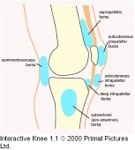
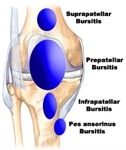
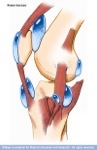
But then, let’s not forget why most knee pain arises: the bursae.
A bursa is a synovial fluid-filled sac between a muscle and bone. This bursa is LOADED with pain reception – as a warning to stop the friction of a structure across the adjacent bone.
I have my fair share of patients that blame knee pain on torn menisci, “bone on bone” osteoarthritis, the like. But my elderly patients full of degenerating joints many times get quick relief from pain with our work.
Did I repair torn structures, like menisci? No.
Did I reverse degenerating knee joints? Unlikely.
I help them improve their movement, so they stop irritating the knee bursa.
While my approach may not be novel, it’s a nice alternative to surgery! It would also explain why knee pain doesn’t always resolve after surgical procedures.
Get to know your knee bursae. Consider that the knee might be hurting because its working too hard, rubbing structures across pain-sensitive bursae.
Eliminate this potential by getting assessed and corrected by a movement professional.
Delay your surgery, and give therapeutics a shot before going under the knife.
Additionally, read the Moseley research, to understand that knee pain is not even just structural or functional, but also could be in your mind.
(http://www.nejm.org/doi/full/10.1056/NEJMoa013259)
Go to a surgeon, and you can’t be surprised if surgery is recommended.
Assess your options.
As always, it’s your call.
– Dr. Kathy Dooley