Dooley Noted: 3/2/2014
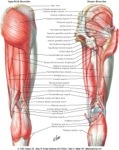
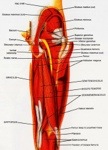
The five muscles of the posterior thigh are often collectively regarded as “hamstrings.”
They tend toward tightness, and people LOVE to stretch what is tight.
Before you stretch, you may want to learn more about what you are stretching – and consider why they are so tight all of the time.
The five muscles often deemed as hamstrings include the following:
1. Short head, Biceps Femoris (BF)
2. Long head, Biceps Femoris (BF)
3. Semitendinosus (ST)
4. Semimembranosus (SM)
5. Adductor Magnus – Hamstring head (HH)
But don’t let these four fool you into believing they all four work the same.
To be a true hamstring, one must follow three rules:
1. Arise from the ischial tuberosity (sit bone), to extend the hip
2. Cross the knee, to flex it
3. Receive innervation by tibial nerve, for coordinated contraction
The only three muscles to follow all three rules are ST, SM, and Long Head BF.
Short head BF only follows rule 2. Adductor Magnus HH only follows rules 1 and 3. Collectively, they act as a hamstring. But that doesn’t really count.
In the lab, you literally see the Short Head BF and Adductor Magnus HH attach to the femur’s linea aspera, as if one is picking up where the other left off.
But they are one-joint muscles, making themselves huge compensators when the two-joint, true hamstrings fall short.
Stretch out all the hamstrings, and you might be stretching something that is insufficiently contracting or stretched already!
The Short Head BF is stretched in knee extension with no hip involvement.
The Adductor Magnus HH is stretched in hip flexion, with no knee involvement.
The take home point? Don’t just stretch for the sake of stretching. Find out which one is tight, and if they are preventing other hamstrings from doing their job.
Get assessed. Get corrected.
Those hamstrings, true or false, might be the things holding you upright! And, they might not all need to be stretched.
As always, it’s your call.
– Dr. Kathy Dooley