Dooley Noted: 3/14/2014
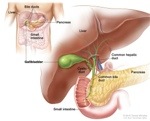
The gall bladder is a small organ on the liver’s inferior surface. It functions to store bile and chop your consumed fats into small pieces to aid their digestion.
With the misconception of “healthy” low fat dieting, gall bladder pathology has been on the rise for decades. This causes the gall bladder to become sluggish and create stone formation.
People at particular risk are the “4 Fs”:
1. Female (gender)
2. Fat (obesity)
3. Forty (years of age)
4. Flatulence
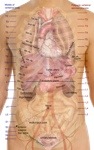
The gall bladder is located in the mid-clavicular line, at the level of the right 9th rib.
Want to find yours?
Divide your collarbone in half with the fingers, spread from throat to shoulder. From the halfway point, trace your fingers down until you run out of ribs. That’s the approximate location of the gall bladder.
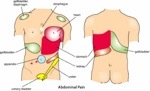
You might experience discomfort in this location when the gallbladder is in distress. Or, you may experience right shoulder pain and difficulty inhaling.
The gallbladder is intraperitoneal, meaning a sling of abdominal connective tissue encases it. This same peritoneum is found under the diaphragm. Both the diaphragm and its local peritoneum are innervated by the phrenic nerve.
When the diaphragm gets irritated, a load of sensory information enters the spinal cord via the phrenic nerve (C3-C5). With much cross talk at the spinal cord, the brain gets confused, misperceiving gall bladder information as shoulder pain. This is because your shoulder sensation is supplied by C3-C5.
Isn’t that amazing? You can be doing all the shoulder rehab in the world, and your shoulder pain may be coming from your gall bladder dysfunction!
Some patients with right shoulder pain trace a line of discomfort along the gall bladder in front, around the side, and to the back, near the inferior tip of the shoulder blade.
If this reads like someone you’ve seen or know, clear the person for gall bladder pathology.
Some quick tips:
1. Avoid low fat dieting and high fat dieting. Low fat dieting slows gall bladder function. High fat dieting can demand too much out of the gall bladder. Keep it moderate.
2. Eat moderate, healthy fats, like coconut oil, fish oil, and olive oil for healthy gall bladder contraction.
3. Pair moderate oil consumption with vegetables, to improve digestion and absorption of fat soluble vitamins.
4. Add lemon juice to oil and vegetables to improve dilation of bile ducts.
5. The amino acid L-ornithine is also helpful in the dilation of biliary ducts.
6. The gall bladder cleanses itself just fine. Avoid “gall bladder cleansing,” a potentially dangerous and aggressive formula that can cause stones to obstruct the biliary system.
7. If one feels discomfort 20 minutes or so after eating a heavy fat meal, gall bladder dysfunction might be present.
8. It may sound gross, but importance lays in checking the stool formation. If it appears greasy and floats, fat is not properly being digested. One reason may be gall bladder dysfunction.
I’ve dissected hundreds of gall bladders, almost all of which had at least minor stone formation. Stones don’t equate to poor gall bladder function. Don’t feel pressured to expel stones.
Get assessed if you are a candidate. Clean up the diet and moderate healthy fat and oil consumption. If you’re in the high risk “4F” category, ultrasound imaging may also be helpful.
As always, it’s your call
– Dr. Kathy Dooley