Dooley Noted: 4/30/2014
In all my time spent learning human movement, it was barely stressed in my education the importance of observing eye movement.
Then, my NeuroKinetic Therapy level III training spent hours on it.
I became fascinated with how eye movement is linked to global movement patterning.
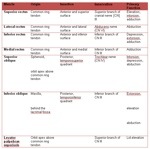
Six extraocular muscles rotate the eye along 3 movement axes. Four straight (rectus) muscles strap around the equator, north and south poles of the eye globe. Two oblique muscles pulley around the eye to provide angularity to movement.
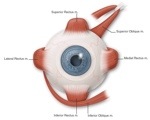
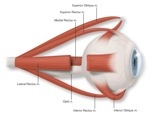
Look down at your pinky. These tiny extraocular muscles are not even half the pinky’s thickness and length. Yet, these muscles work with the vestibular system to show you where you are in space, relative to the horizon.
Different muscles are tightening and lengthening at any given movement to coordinate with the opposite eye. This picture below shows how the muscles work together:
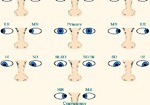
Where the eyes move, the head and spine tend to follow. If you are always looking down, the head and spine will tend to fall into flexion. The same is true for looking up and to the sides, with the head and spine following eye movement.
If the desired goal is rotation sound a certain axis, the observer must be keen on eyes leading the movement.
The same is true for preventing a motion. Desire for the client to not hyperextend through the low back? Don’t let them look up to much.
Neutral eye movement = tendency towards neutral spine
If a patient had a flexion intolerant low back, they must be coached to avoid looking down too much.
Global movement can also be coached relative to eye movement. If the goal is to teach a patient or client to crawl with a neutral spine, I want eye looking ahead, with full joint centration in spinal neutral. I don’t want the client looking down OR up if neutral is the goal!
If the kettlebell swing has too much low back extension, don’t let the client look up.
If core sequencing is difficult to maintain for breathing calmly, walking or running – where is the client looking?
Give eye movement one day of your attention, and watch the results you obtain from your self. Then, teach your clients and patients how to use this reflexive eye movement to improve global movement patterning.
As always, it’s your call.
– Dr. Kathy Dooley