Dooley Noted: 6/18/2014
Balance can be an elusive concept.
Just when you think you strike it, something may throw you off kilter.
This is something to be applauded, not avoided.
Babies have zero fear of falling down. Watch them fall. They do it incessantly, as their freaked-out parents attempt to catch them. But when left to their own devices, babies fall on repeat.
Then they try again.
They know to fall is not to fail. It’s the only way to learn true balance. They know intrinsically what we learn by observation.
To experience equilibrium with the environment around you, you need 2 of these three systems working for you:
1. Vision
2. Vestibular system
3. Proprioception
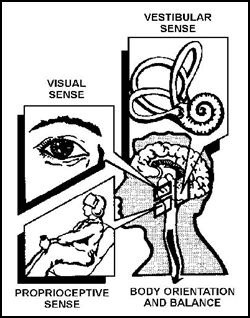
So, most of us are aware that we get clumsy in a dark room. But that is only vision getting knocked out.
Now, the demand is placed on 2 and 3, since you need two systems working. If you fell, you knocked out 2 systems.
The vestibular system includes a fantastic set of stones in your ear with receptor cells that respond to positional changes. The inner ear contains canals with salty fluid that can move to create an action potential, sending special sensory information to connect the position changes of the spine, neck, and eyes.
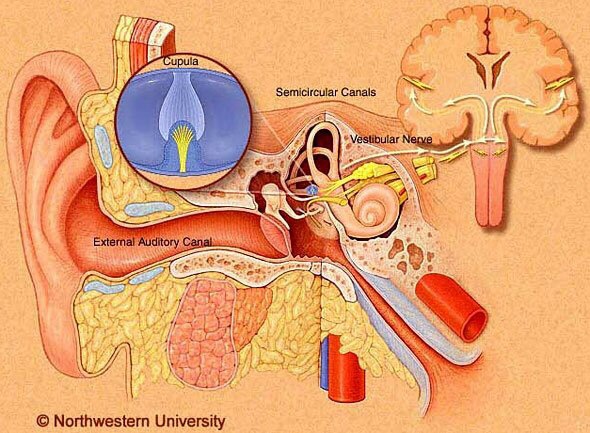
If you’ve ever experienced vertigo or motion sickness, you are acutely aware of how the vestibular system helps you balance.
The proprioceptive system is the positioning sensing of the body. It is a general sensation carried by a few separate pathways that connect to your cerebellum. They help you orient the body relative to its surroundings.
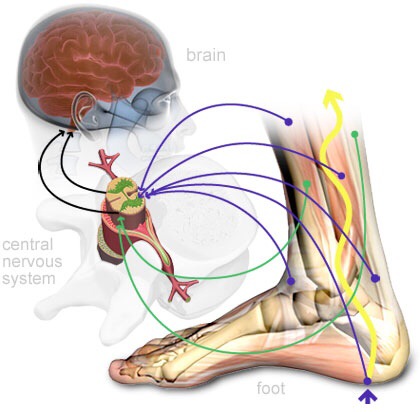
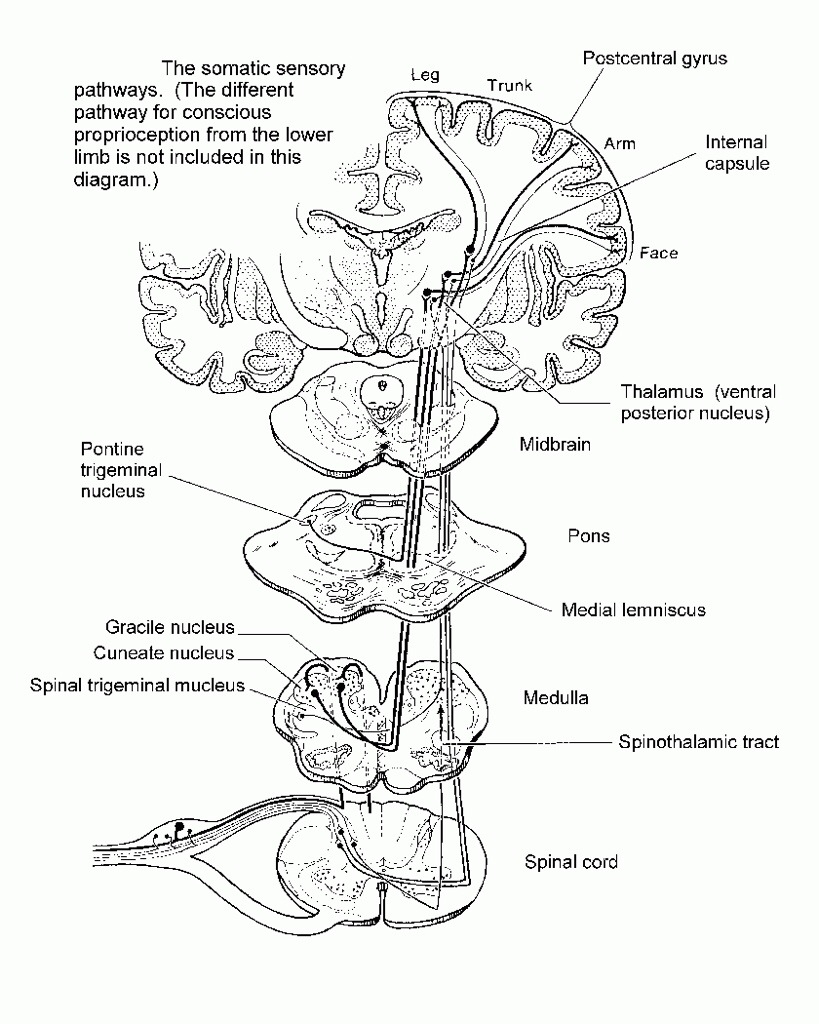
If you’ve ever spun in circles or been inebriated by alcohol, you are acutely aware of this system’s effects on balance.
My patients with troubled vision have to depend even more on the vestibular and proprioceptive systems to obtain equilibrium.
But what if we work to use vision less in our own balance improvements?
We can depend more on the vestibular and proprioceptive systems to help us stabilize relative to our environment.
Demand the system, and it responds.
Your nervous system can get lazy, attempting to maintain its current homeostasis. Perhaps you can shake things up with the following tips:
1. Train in barefeet.
2. Remove vision in a safe environment to demand more of the other systems.
3. Experiment with improving proprioception through changes in textures, temperatures, and other sensory changes to alter the environment.
4. Improve hydration to help normalize salt concentrations in the inner ear.
5. Consider avoiding the use of substances that alter equilibrium, such as alcohol and certain medications.
6. Demand, demand, demand the systems to accommodate. Alter the learning environment. Change the room around. Change the activity in subtle ways to which the system must adapt.
7. If the proprioceptive or vestibular system have been dramatically compromised, visual acuity training can improve balance.
You don’t have to do squats atop a bosu ball to create an environment for obtaining balance.
Start on the ground, and shake up the systems.
As always, it’s your call.
– Dr. Kathy Dooley