Dooley Noted: 9/5/2014
If Brachialis is the unsung hero of elbow flexion (See: Anatomy Angel: Brachialis), then Deltoid is the unsung hero of shoulder flexion.
This muscle is enormously useful to get you out of that failing bench press, or to basically lift anything over your head.
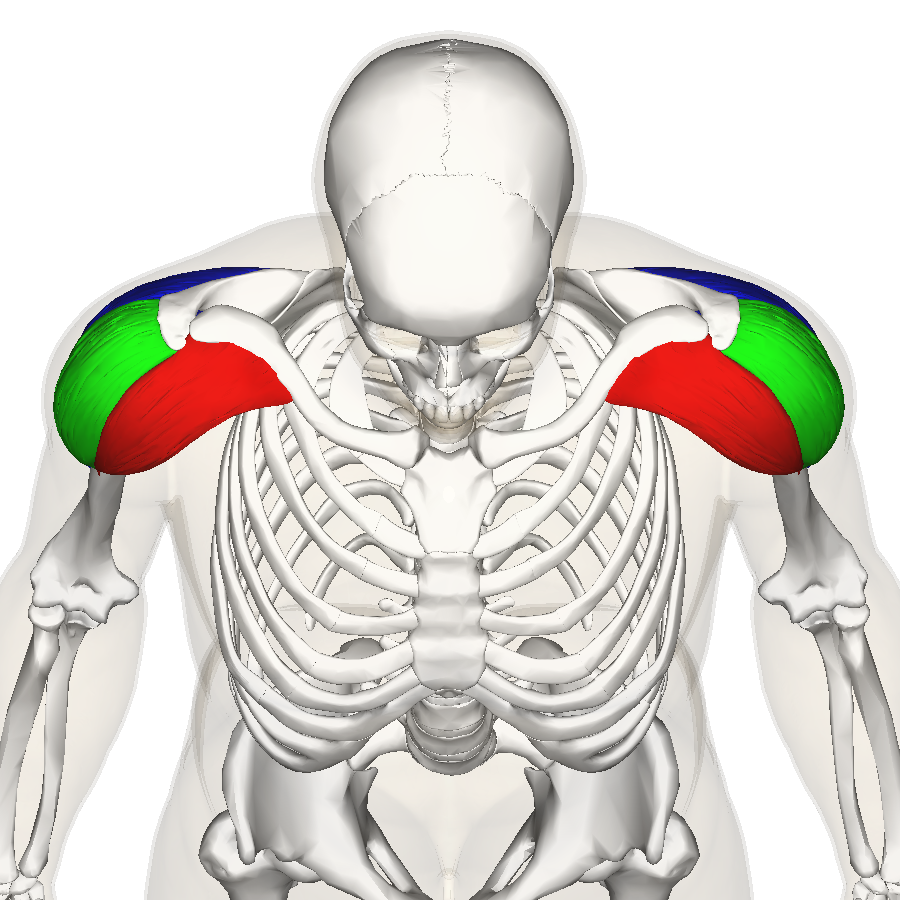
Like the Pectoral muscle group, Deltoid can flex, internally rotate, and horizontally adduct with its anterior fibers.
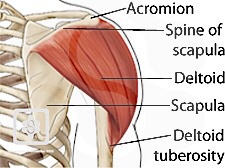
After the first 15 degrees of humeral abduction, the intermediate (middle) Deltoid brings you the rest of the way up, with huge help from serratus anterior.

The lesser discussed but crucially important posterior fibers of Deltoid work with Latissimus, Teres Major, and Long Head Triceps Brachii to extend the shoulder.
This muscle is busy and is a powerhouse of a prime mover! But if you have neck issues, its nerve supply may be under compromise.
Like all rotator cuff muscles, Deltoid is largely innervated by C5, the very spinal nerve most commonly impinged by a herniated disc in the neck. (The C5 spinal nerve travels between C4 and C5 vertebrae, the most common herniated cervical disc level.)
So, neck instability not only leads to a weakened Deltoid but a weakened rotator cuff. Now, your shoulder movement AND stabilization are both compromised.
But don’t fret.
While you rehabilitate your neck to better supply your shoulder, the other big prime movers have a chance to finally be demanded to do their jobs.
All the previously mentioned Deltoid synergists have a huge quality in common: none have C5 as a major spinal level. They can do pretty well without it.
You want Deltoid power. And you want a stable neck. They go hand in hand.
If you lack pressing power or struggle getting the arm overhead, consider the Deltoid and it’s relationship to the neck.
Demand more out of your synergists (i.e., latissimus, pectorals, etc.) while you are rehabilitating these structures, never forgetting the connections.
As always, it’s your call.
– Dr. Kathy Dooley