Dooley Noted: 5/31/2015
Hernias can happen to the best of us.
A common type of hernia is a direct Inguinal hernia, where peritoneum (abdominal connective tissue) and intestines can extrude through the anterior abdominal wall.
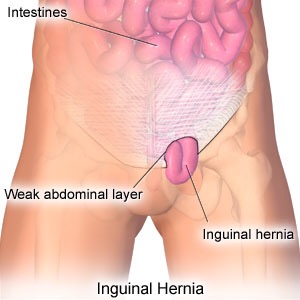
This triangle’s borders include the following structures:
1. Lateral edge of rectus abdominis
2. Inferior epigastric artery
3. Inguinal ligament
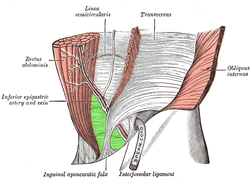
This area is susceptible to hernia due to the absence of a posterior rectus sheath.
The posterior rectus sheath is formed from aponeuroses (broad, flat tendons) of internal abdominal oblique and transversus abdominis muscles. This posterior sheath joins the anterior sheath to attach to the linea alba, thus fortifying the contraction of rectus abdominis in the building and release of intraabdominal pressure.
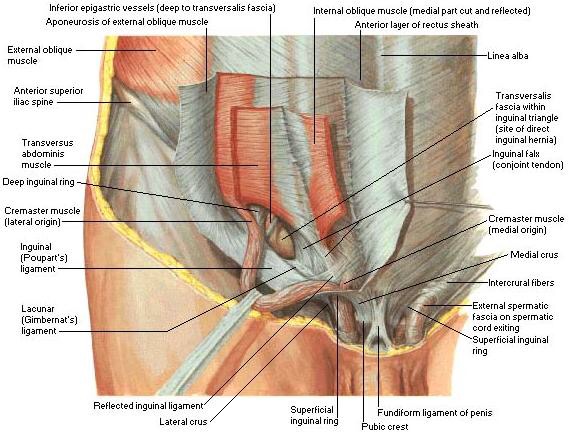
But – in the inguinal triangle, the posterior sheath is not present, leaving the abdomen with a zone of potential weakness when pressure is built.
Since we all bear this anatomical weak zone, it’s crucial to learn to properly build and release intraabdominal pressure.
Most people bare rib flares, lumbar and lower thoracic hyperextensions, breathing dysfunctions, and improper lifting techniques that increase the chances of inguinal hernia.
Hernias are remarkably painful if the peritoneum is irritated, giving stabbing localized pain and extruding abdominal contents at risk for strangulation.
To prevent these disfiguring, possibly painful, and potentially dangerous hernias, consider getting your breathing analyzed to see if you properly build intraabdominal pressure.
Look for assymetrical tightness or contractions of the diaphragm, pelvic floor, abdominal obliques and transversus abdominis, and other core muscles.
If you can’t properly build pressure, you leave yourself at risk.
As always, it’s your call.
– Dr. Kathy Dooley