Dooley Noted: 8/11/2015
My interest in acupuncture started in chiropractic school.
I received a 300-hour certification in acupuncture after attending 8 weekend seminars on the subject.
I then sat for an acupuncture board examination to allow me to practice it as a chiropractor in 47 out of 50 states.
Knowing the theory and practice of Chinese medicine ran deeper than 8 weekends, I knew I had the Cliffs Notes version of what I needed to know.
Lucky me.
I moved to one of the three states where chiropractors can’t practice acupuncture with their board certification.
(Mind you, medical doctors can. But I’ll digress, so as not to get ticked off.)
I left my acupuncture studies behind and started my masters studies in anatomy. My stress and underlying issues amalgamated into severe migraines, occurring about three days a week.
So, I did what many people would do.
I went to my GP, who then referred me to a neurologist.
The neurologist proceeded to give me the worst neurological exam I ever envisioned.
I had to beg for imaging.
Subsequently, he told me two days later – over the phone – that I had a posterior cerebral aneurysm and may need neurosurgery.
Scared out of my mind, I took his advice and swallowed his cocktails of Imitrex and trypsins.
I was so sleepy I couldn’t study.
My teaching and student performances waned, but hey! No migraine for that day.
That is, until the next day, when the migraine returned full force.
So, I popped more meds.
The coup d’gras was when I took a four-hour bus to NYC, only to hold my nausea until I reached a bathroom.
Only, I didn’t make it.
I projectile vomited along the outer wall of Port Authority.
Somehow, I managed to get to my friend’s apartment, where I laid on the floor, contemplating my mortality.
I said, “If this aneurysm is going to take me out, I’m not doing it drugged up and puking at a bus stop.”
I pitched the meds, and I never went back.
I returned home to a call from my neurologist, who said I was misdiagnosed due to a film artifact.
No aneurysm existed.
(Be careful marrying those fancy MR images to a diagnosis.)
I decided to choose a different route.
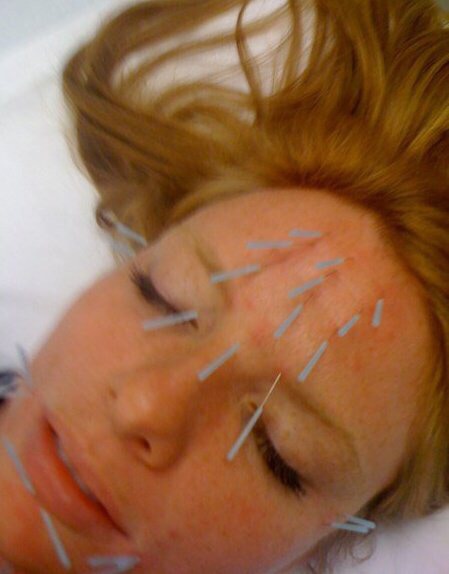
I started weekly treatments with acupuncture and herbs.
Although my acupuncturist said I could stay on the medications with my alternative treatments, I wanted to see if I could recover with Traditional Chinese Medicine (TCM) alone.
It wasn’t fast.
It took some time.
But here I am, medication-free, with migraines that rarely occur.
I could have been popping those meds for an eternity.
Instead, I found a system of treatment that didn’t treat me like a symptom that needed to be dampened.
TCM treats the individual.
And not all migraines – nor people – are created equally.
Why would people take the same medications?
My TCM practitioners looked at me as a series of patterns, each of which needed to be addressed to treat the person.
TCM saw my migraines, eye floaters, jaw dysfunction, constipation and menses as a particular pattern.
Then, my treatments were tweaked based upon my answering ten important, consistent questions.
These questions served as a review of systems, to see how my body functioned as a unit.
It wasn’t a magic bullet pill. The pills the neurologist offered me had me puking at Port Authority anyway, so magic bullets were not my thing.
I was ready to face my system head-on and be a more patient patient.
And lo and behold, TCM started clearing up other symptoms I thought weren’t migraine-connected,
The constipation improved.
My appetite was tempered.
My mood and menses were much more tolerable.
The eye floaters lessened.
I was amazed at the theory behind my treatments, which was explained in detail at each of my visits.
I was never discouraged from using Western medical services, but I felt less of a need to utilize them.
I run like a wellc-oiled machine, in part because of TCM.
And I’m a better practitioner for studying this ancient medicine with thousands of years of staying power.
I’m damn proud to call myself a student, recipient, and future practitioner of TCM.
It works, alone and in conjunction with other therapeutics.
It may be worth a shot if your current healthcare seems incomplete.
As always, it’s your call.
– Dr. Kathy Dooley