
Dooley Noted: 3/10/2016
I failed my first physics test in college.
But, with the help of my tutor, Lee Ditsworth, I aced the course.
Before I aced it, I learned much from my failure.
I paid attention the day we discussed the length-tension curve.
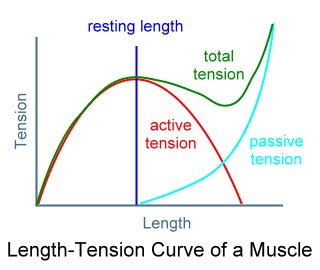
This concept was applied again when I started to learn muscular action.
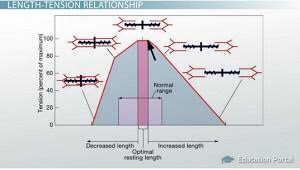
I understand now why physics is a required course for medical school – because one cannot understand human power without understanding this concept.
Most people learn anatomy one way.
They learn the actions of muscles when they are short.
I’ll provide an example.
The superior oblique muscle of the eye, when concentrically contracted (shortened), can move the eye down, out, or into internal rotation.
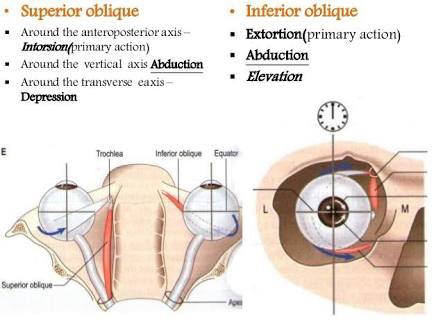
But – it can’t do all of those actions with ultimate power at the same time.
This is the basics of length-tension curve: you can only be powerful on one axis at a time.
You know this if you’ve been to the optometrist or a physician, and they have you follow their finger as they make an “H” for the cardinal sign of gaze.
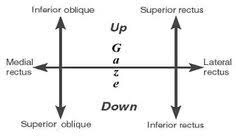
The superior oblique is clinically tested for its power to depress the eye by moving the eye IN.
This is also when a patient gets blurry vision from a lesion to this muscle: when the patient is depressing the eye after it first adducts it. This can be while she reads the paper or walks down a flight of stairs.
This is when my students freak out:
“Dooley, if the superior oblique moves the eye down and out, why does the patient have trouble looking down and IN?”
I remind them of the laws of physics, often using a rubber band as an analogy.
I ask a simple question to help anatomy meet physics:
“If you want to fling a rubber band across the room, what do you do to it first?”
The answer is always the correct one:
“You pull it back first.”
If a muscle is already short on one axis, it can’t be a prime power generator on another axis.
Since the eye is moved inwards (adducted), this stretches the superior oblique, allowing it to be pulled back like a rubber band to fire powerfully into depression if requested to do so.
Only it can’t do this when injured. Thus, the patient gets double vision when the eye moves down after being pulled IN.
So, if you are memorizing muscles for what they do when they are short, rethink the length-tension curve.
And remember one basic physical law: you can only be a great power generator on one axis at a time.
If you want adductor magnus to help you internally rotate the femur, don’t ask him to first shorten as a hamstring would in hip extension.
If you want latissimus dorsi to help you with humeral extension in a row, don’t ask him to first internally rotate that same humerus.
You’ll be leaking potential power and attempting to defy the laws of physics.
Use physics in your favor.
If you want to learn more about concentric and eccentric pairing/loading, feel free to attend an Immaculate Dissection seminar.
Feeling physics is believing.
As always, it’s your call.
– Dr. Kathy Dooley
P.S. Thanks, Lee, for helping me understand physics. It paid off more than you know.