Dooley Noted: 7/24/2016
This image is making its way around the internet today.
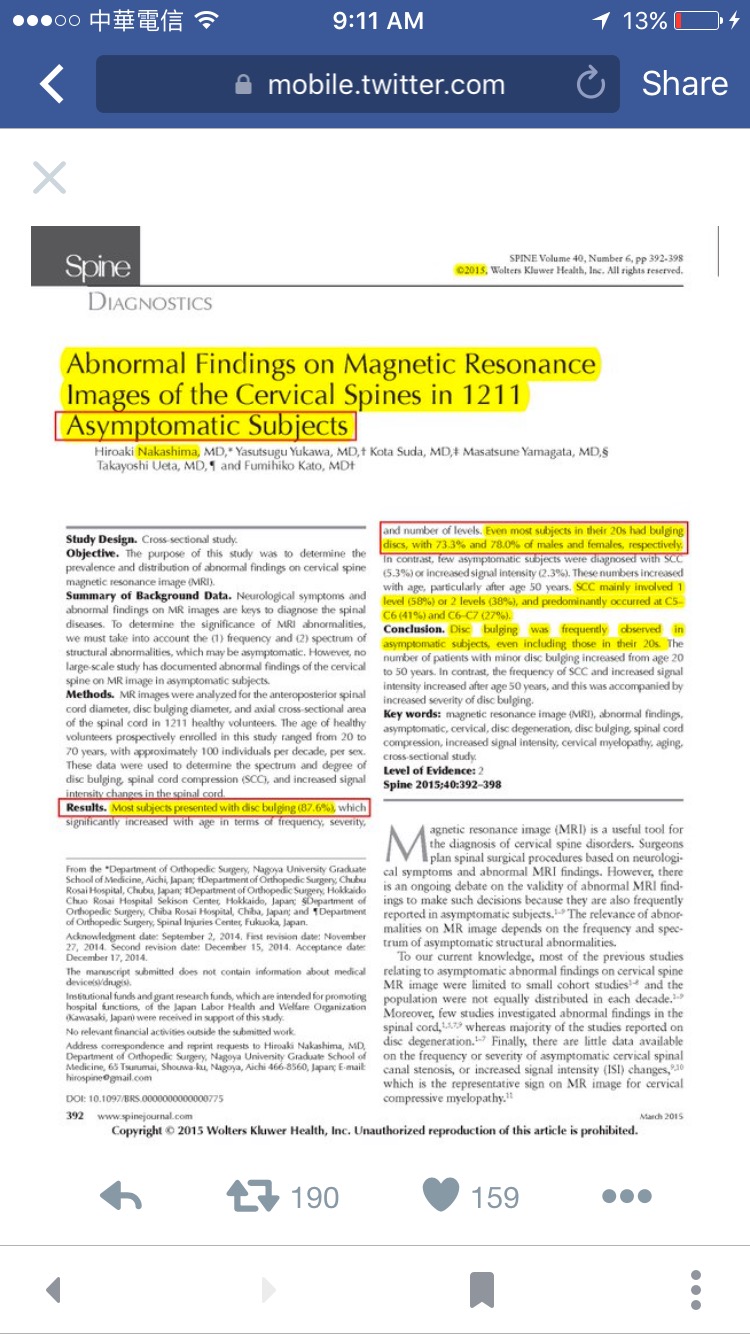
The findings from the high impact factored, peer-reviewed journal, Spine, showed that over 86.7% of cervical disc herniations were asymptomatic.
Although the research clearly shows this truth, pain is often explained by radiographic findings by their doctors and therapists.
It’s time to stop this madness.
Disc herniations occur due to excessive motion at one segment without load-sharing between other segments of the system.
This commonly occurs in the cervical spine at its lower segments, just as it does in the lumbar spine.
In people who are symptomatic and asymptomatic, I highly suggest teaching the spine to properly load-share between segments.
Your level of discomfort cannot be described primarily by disc herniations, since most of us live long enough to develop them. By all means, encourage the system to move more freely.
But, don’t use radiographic findings to provide a full explanation to why you experience discomfort.
Learned behaviors can create discomfort.
Emotional situations can create discomfort.
Referred pain from organs can create discomfort.
Make sure that you assess the patient’s entire clinical picture, instead of scaring them with the fact they have radiographic findings.
And if you have disc herniations found on imaging, do not fret.
86.7% of people around you with no symptoms also have them.
Get assessed. Get corrected. Look at the multifactorial components of why you may experience discomfort.
As always, it’s your call.
-Dr. Kathy Dooley