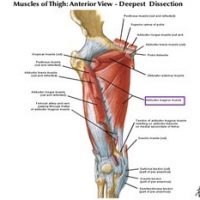
Anatomy Angel: Adductor Minimus 

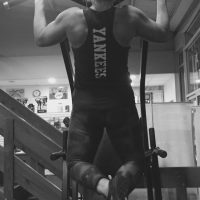
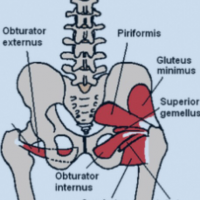
Dooley Noted: 1/8/2016   The Adductor Minimis head of Adductor Magnus muscle is a seldom-discussed head that needs more clinical attention.    This week, my business partner, master trainer Joe Boffi, was noticing a limitation in his right hip external rotation. He felt it lock up as he tried to squeeze the glutes and press a kettlebell overhead.    He pointed to a round sore spot that had created a palpable swelling, inferior to the … Read more
Anatomy Angel: Sciatica

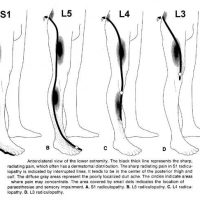
Dooley Noted: 12/22/2015   I fully appreciate when people outside the health professions know anatomical or diagnostic terms.   These include anything from iliotibial band to carpal tunnel syndrome to one of my favorite diagnoses: sciatica.   The general public regards sciatica as any pain emanating from the back and traveling down the leg.   Perhaps some anatomical clarification is in order.   In sciatica, the sciatic nerve is the nerve if interest. It is … Read more

Anatomy Angel: Abductor Hallucis

Dooley Noted: 12/15/15   The Abductor Hallucis is the primary mover of the great toe medially (relative to the body) away from the second toe.     This concentric action, known as great toe abduction, is crucial for spreading the surface area of the forefoot during foot pronation.     The eccentric loading of this muscle is important during propulsion, helping the great toe load and explode via the powerful movement of an elongated Flexor Hallucis Longus.  … Read more

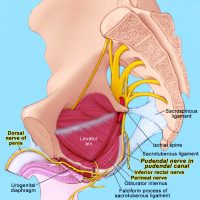
Anatomy Angel: Pudendal Neuropathy 

Dooley Noted: 11/30/2015    The pudendal nerve is a somatic peripheral nerve carrying both sensory and motor fibers to an array of structures.   Since the word “pudendal” means “to be ashamed,” the structures supplied by this nerve are things one finds covered by their underwear.    The muscular structures include portions of the pelvic floor, the external anal and urethral sphincters, and perineal muscles.    The sensory structures include the vaginal and anal canals, … Read more

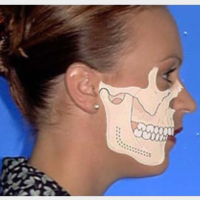
Anatomy Angel: Jaw Protrusion/Retrusion and Center of Mass

Dooley Noted: 11/21/2015   In a recent NKT study group, we discussed how overbite (jaw retrusion) and underbite (jaw protrusion) can affect the intrinsic and extrinsic core systems, creating global compensations in the kinetic chain.   The lateral and medial pterygoids are the chief muscles of protrusion of the mandible. The superficial head of the masseter acts as a secondary synergist to their action.        Protrusion = Pterygoids  (Remember that the Ps go together!) … Read more

Anatomy Angel: Multifidus Lumborum

Dooley Noted: 11/3/2015   The multifidii group of musculature is part of the deep intrinsic spinal stabilization system.     The multifidii belong to a subset of back muscles called transversospinalis. These muscles usually attach from the transverse processes to the spinous processes of vertebrae.   The multifidii cross 2-4 vertebral segments, attaching to the respective transverse process. This makes multifidii a fantastic local intersegmental stabilizer, as well as a local mover for extension, lateral flexion, … Read more

Anatomy Angel: Levator Scapula 

Dooley Noted: 10/20/2015   The Levator Scapula (LS) is a neck and scapular muscle that is short and powerful – not unlike the author of this article.   LS attaches to C1-C4 vertebrae at the transverse processes, making it a fine lateral neck flexor (same side bender) of the scapula is fixed.     LS also attaches to the superior angle of the scapula, right where most of my patients have what I affectionately deem a … Read more

Anatomy Angel: Grief and Breathing 

Dooley Noted: 9/30/15   In the past two weeks, I battled a serious upper respiratory tract infection.    All phlegm was clear, and I noticed a huge emotional component to its onset.   This got me thinking of the anatomy of grief and breathing.   Our limbic system is part of the central nervous system that controls Homeostasis, Olfaction, Memory, and Emotion.     Therefore, I like to say the limbic system takes us “HOME.”   … Read more

Anatomy Angel: Hip Compression

Dooley Noted: 9/21/2015   The hip joint is s ball-and-socket, triaxial joint with enormous movement potential. As the femur (thigh bone) makes the joint with the acetabulum (pelvic landmark), the hip moves into flexion, extension, abduction, adduction, internal and external rotation.              In a healthy, properly mobilizing system, the hip naturally compresses and decompresses as it moves through space.    As the lower extremity swings through gait, the hip naturally compresses. … Read more

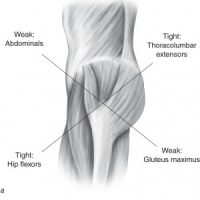
Anatomy Angel: Gluteus Maximus and the Knee

Dooley Noted: 9/14/2015   This weekend, I taught NeuroKinetic Therapy (NKT) I in New York City. Our wonderful teaching team showed students the relationships between hip structures and the knee.   Now that the research has finally stopped blaming Vastus Medialis (VM) for most of knee problems, the attention has been put on Gluteus Medius (G Med).    Through its ability to properly compress the hip, G Med helps to control the valgosity of the … Read more