Anatomy Angel: Finger Flexion and Median Neuropathy

Dooley Noted: 9/6/2015   Carpal tunnel syndrome is one of the most misdiagnosed neuropathies of the human body.   While I am always appreciative of patients dropping anatomical terms, any type of numbness and tingling of the hand is usually deemed carpal tunnel syndrome.   But it’s not the patient’s fault.   I’ve seen more cases than I can count of patients presenting to me with a misdiagnosis of carpal tunnel syndrome from a healthcare … Read more

Anatomy Angel: Why You Use Jaw for Motor Control

Dooley Noted: 8/25/2015   I see my share of patients with jaw dysfunction.    What impresses me is that patients don’t just call it the jaw. They refer to the temporomandibular joint (TMJ) by its anatomical name.    Laypeople point right to the joint and its musculature. They have an understanding of its power and compensatory abilities when they have discomfort.       They ask me every day: Why does the jaw take over for movements … Read more

Anatomy Angel: Iliolumbar Ligament

Dooley Noted: 8/8/2015    The iliolumbar ligament is a very deep, important ligament which is famous for being the inferior attachment of quadratus lumborum (QL) and the superior attachment of iliacus.    But why is that connection crucial?   This ligament is attached to many more important structures, and its anatomy must be appreciated.   The iliolumbar ligament gets its name from its connections to the L4 and L5 transverse processes medially and its lateral … Read more

Anatomy Angel: Popliteus

Dooley Noted: 7/8/2015   Popliteus is a muscle of the deep crural (leg) compartment. Buried under the enormous bellies of gastrocnemius, this muscle is found beneath its own fascia on the back of the knee. The muscle is located directly superior to the soleal tibial line, where soleus attaches.         Popliteus is innervated by the tibial nerve, like most of the posterior kinetic lower limb chain. This means that low back function – particularly, … Read more

Anatomy Angel: Gastrocnemius

Dooley Noted: 6/23/15   The gastrocnemius is a two-bellied, powerful muscle that forms 2/3 of the triceps surae, along with the soleus.      The triceps surae form the most powerful plantar flexors of the ankle, allowing one to propel forward off the back foot during gait, sprinting, jumping, and other propulsive activities.     The gastrocnemius is the multi-joint muscle of the triceps surae, moving both the talocrural (upper ankle) joint and the knee. … Read more

Anatomy Angel: Inguinal Triangle

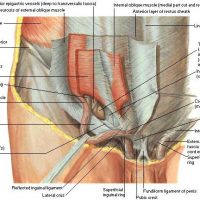
Dooley Noted: 5/31/2015   Hernias can happen to the best of us.     A common type of hernia is a direct Inguinal hernia, where peritoneum (abdominal connective tissue) and intestines can extrude through the anterior abdominal wall.       This triangle’s borders include the following structures: 1. Lateral edge of rectus abdominis 2. Inferior epigastric artery 3. Inguinal ligament         This area is susceptible to hernia due to the absence of a … Read more

Anatomy Angel: Obturator Externus

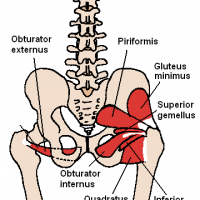
Dooley Noted: 5/17/2015 The deep six lateral hip rotators are a fascinating group of muscles.       They are so deep and perplexing that even researchers aren’t quite sure what they do in every plane.     Regarding concentric load: The biomechanical authorities tend to agree that these 6 muscles lateral rotate the femur, relative to the hip if it’s already extended. These muscles (except for quadratus femoris) abduct a femur, if the hip is … Read more

Anatomy Angel: The Sacroiliac Joint

Dooley Noted: 4/28/2015 The sacroiliac (SI) joint is an enormously stable joint that has both fibrous and fully moveable components.  The auricular surfaces of both the ilium of the hip bone and the sacrum articulate to form this joint.     Even in our youth, this joint seeks more stability than mobility. The anterior and supremely dense posterior sacroiliac ligaments anchor the bones to each other, while serving as anchor points to important ligaments attaching to … Read more

Anatomy Angel: Rectus Femoris

Dooley Noted: 4/20/2015 Rectus Femoris (RF) is a glorious, long muscle that crosses both the hip joint and the knee joint. RF has similarities with the rest of quadriceps femoris. It shares an innervation in the femoral nerve (L2-L4) and a common distal attachment onto the tibial tuberosity. As a quad does well, RF extends the tibia.   With the major spinal level being L4, the innervation is more seldom compromised by disc herniation. This … Read more

Anatomy Angel: Short Head, Biceps Femoris

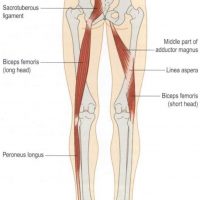
Dooley Noted: 4/14/2015 I have a strong opinion about what makes a muscle a true hamstring.  One must meet all three criteria.  1. One must be innervated by the tibial nerve, the true oppositional nerve to the femoral nerve.  2. One must extend the femur, relative to the acetabulum (i.e., hip extension).  3. One must flex the leg, relative to the femur (i.e., knee flexion).  Gastrocnemius almost makes it. He has 1 and 3.  Even … Read more